
Amollia Antine
For three days in Washington, D.C., I found myself thinking about that question as I met teenagers from different Jewish Zionist youth movements across North America. We came from different traditions, communities, and perspectives. Yet we were all sitting in the same room, representing different parts of the same Jewish people.
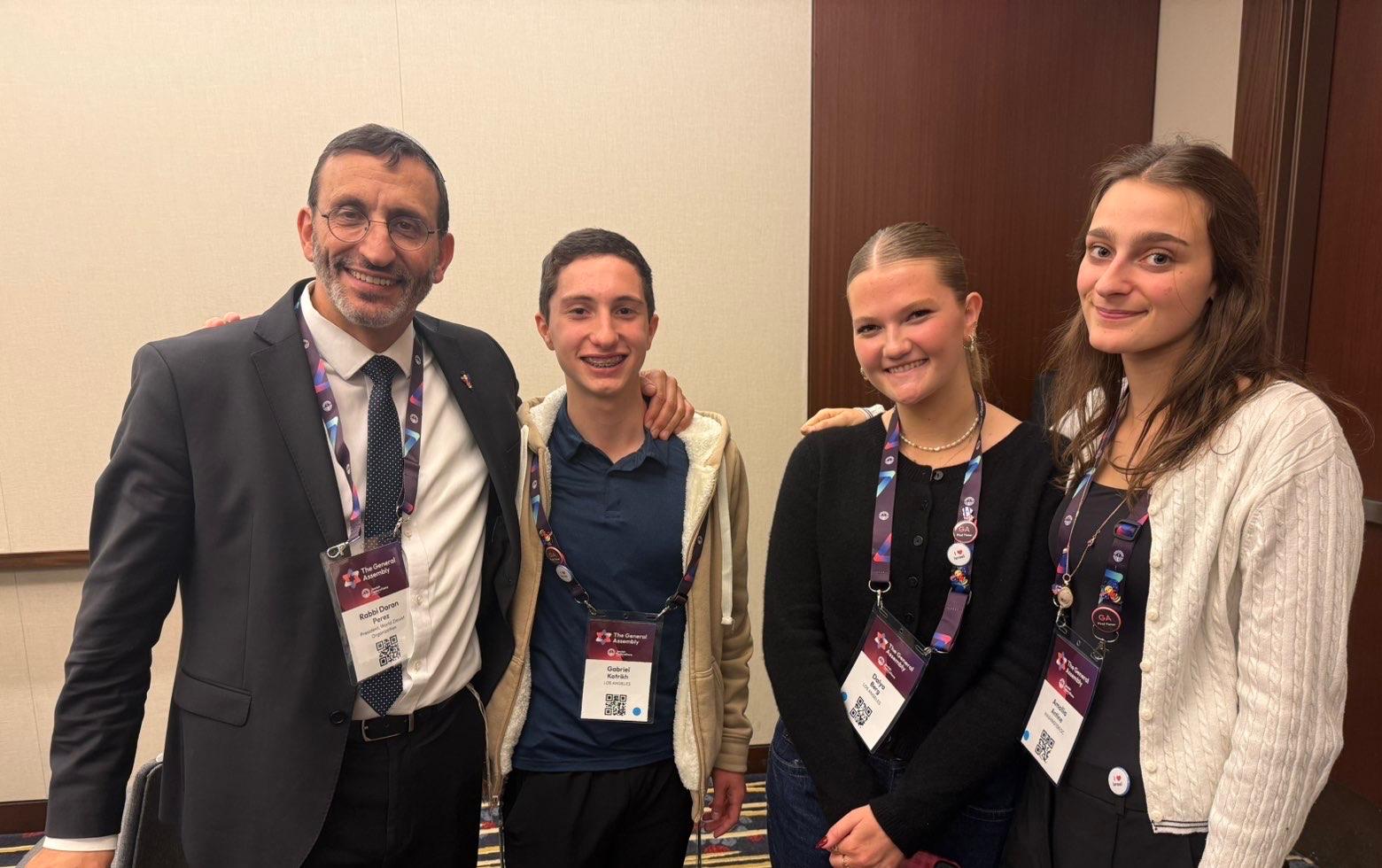
From Sunday, November 8th, to Tuesday, November 10th, I had the honor of representing Bnei Akiva at the General Assembly. I had the opportunity to hear from social media influencers, former secretaries of state, journalists, rabbis, leaders of different Jewish and Zionist organizations, and, just as importantly, learned from the teenagers sitting beside me.
My participation in the General Assembly is made possible through the American Zionist Movement. I am one of three Bnei Akiva representatives among 30 teenagers who serve on the American Zionist Youth Council. I was joined by Dalya Berg and Gavi Katrikh, both leaders in their Bnei Akiva chapter or Sniff in Los Angeles. The council brings together teenagers from more than 10 different Jewish Zionist youth movements. We meet monthly for leadership workshops, hear from guest speakers, and attend conferences together.
I have been part of this program for the past three years, attending three different conferences along the way. One of my favorite parts of each conference has always been meeting the other teens on the council and learning from their different perspectives and experiences.
With so many different movements represented, there is naturally some competition between youth movements. But during the conference, we participated in an activity- or, in Bnei Akiva terms, a peulah. It challenged us to put competition aside.
The instructions were simple: we had to cross a tape line which was across the room, but if the other team stepped on a tape square on the floor, we had to restart. Both groups originally assumed that we were supposed to reach the other side before the opposing group. We focused so much on beating the other team that we missed the actual purpose of the activity. It was only after it ended that we realized the goal had never been to beat the other team; it was to work together. The tape box had simply been a distraction.
We cannot keep stepping on “tape boxes” between the different youth movements. This does not mean we all have to become one; we have different goals, ideas, and approaches to Israel and Judaism, and those differences are worth preserving. But they should not become barriers between us. We are all working toward a stronger Jewish future, and when we support one another instead of focusing on who is “winning,” we can learn from each other and make a far greater collective impact.
That idea of connection across different Jewish communities came back to me during one of the most memorable moments of the conference.
This past summer, I worked at Camp Stone. Yaakov Fleishman, the camp’s co-director, taught the camp a new song called Hashiveinu. It took the tzevet, or staff, a few tries to learn the tune and melody, but eventually we caught on. We sang it together during slow Shira, and it became one of those songs that immediately brings me back to camp.
At the closing ceremony, Hashiveinu was played for everyone to sing. Many of the people in the room did not know the song, but I sang it proudly. As I sang, I thought back to the last Shabbos at Camp Stone, watching my campers sing along. That moment reminded me just how much I was looking forward to returning to Camp Stone this summer.
There was something especially meaningful about hearing it in that room. I was one of only three people representing Bnei Akiva, the only Religious Zionist youth movement on the American Zionist Youth Council. I was part of a community with its own traditions and values, but I was also part of something much larger.
A song I had learned at my Religious Zionist summer camp was now being sung by Jews from across the world and all from many different backgrounds. Something that had felt so specific to my own community had become a shared experience.
Before this conference, I thought Am Yisrael was defined by what we have in common; now, I understand that it is also strengthened by the differences we bring to it. Am Yisrael is not defined by everyone thinking, practicing, or leading in the same way, but by our ability to come together despite those differences. I will continue to be proud of my Bnei Akiva community, from my Sniff to Camp Stone, and of the traditions that have shaped me, while also making space for people and perspectives different from my own. I do not have to choose between being proud of my own Jewish identity and being connected to Jews who are different from me. I can be both.
You may also like
What does it mean to be part of Am Yisrael?
For three days in Washington, D.C., I found myself thinking about that question as I met teenagers from different Jew...
Akivaton Weekly Dvar Torah
While it is true that this week’s Parashah is full of terrible curses and punishments that will befall us if we don’t keep the Mit...
TPG Houston!
By: Ori Friedmann | Shaliach Houston
First TPG of the year was amazing! We had more than 60 people!!! TPG stands for Torah, Pizza, Gym &...